Enterprise software systems frequently degrade into unmaintainable ‘Big Balls of Mud’ because core business logic becomes tightly coupled to external frameworks, database drivers, and third-party UI libraries. When technology choices change—such as swapping PostgreSQL for MongoDB or migrating from REST to gRPC—developers are forced into risky, multi-month code refactors across core domain rules. Clean Architecture (formalized by Robert C. Martin) and Hexagonal Architecture (Ports and Adapters, invented by Alistair Cockburn) solve this through domain isolation, strict layer boundaries, and the Dependency Inversion Principle.
1. The Classical Architectural Pathology: Framework Coupling
To appreciate the necessity of Clean Architecture, consider how typical web frameworks (such as Django, Spring Boot, or Ruby on Rails) structure software by default:
- Active Record Coupling: Business logic is embedded directly inside database entity classes that inherit from framework ORM base classes (e.g.,
class User extends ActiveRecord::Base). As a result, testing a domain rule requires spinning up an entire SQL test database. - Controller Bloat: Web controllers parse HTTP request parameters, invoke database queries directly, execute business validation, and format JSON output within a single 500-line method.
- Fragile Unit Testing: Because domain logic directly imports third-party SDKs (such as AWS S3 or Stripe), writing unit tests demands complex mocking frameworks that reflect infrastructure implementation details rather than business behavior.
- Vendor Lock-in: When third-party cloud SDKs or web frameworks publish breaking API updates, those breaking changes ripple directly into the core calculation and financial logic of the enterprise.
2. The Hexagonal Architecture (Ports and Adapters)
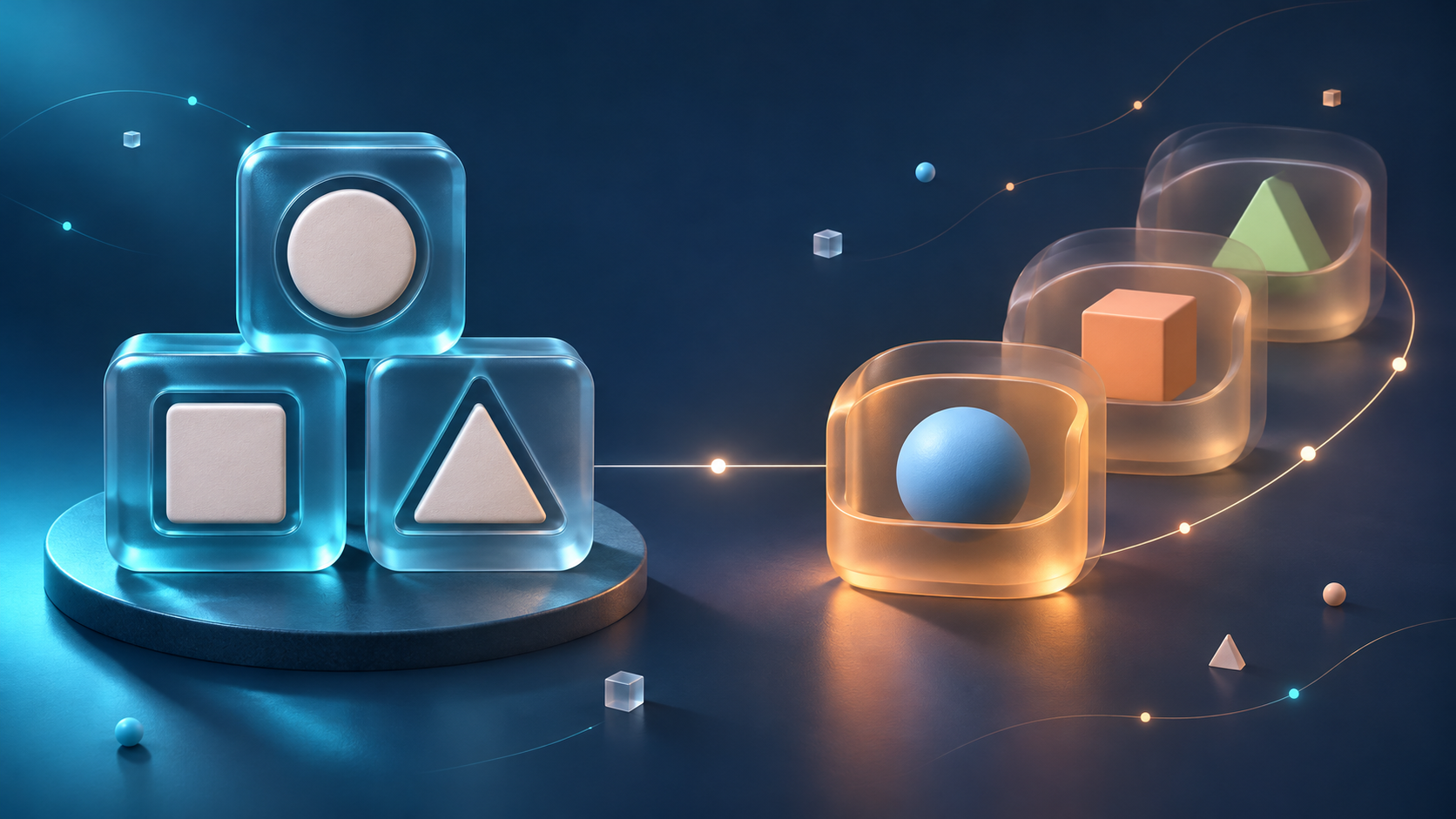
Alistair Cockburn conceived Hexagonal Architecture in 2005 to treat the core application as a self-contained domain surrounded by an isolation boundary (represented conceptually as a hexagon).
A. The Inside: Application Core and Domain Logic
The inside of the hexagon contains purely business logic:
- Entities: High-level business objects encapsulating enterprise-wide rules and invariants.
- Use Cases (Application Services): Orchestrates domain entities to execute specific user operations (e.g.,
RegisterUserUseCase,TransferFundsUseCase).
B. The Boundary: Ports
A Port is a technology-agnostic interface defined strictly by the inside application core. Ports are divided into two fundamental directions:
- Driving (Primary / Inbound) Ports: Define how external actors trigger actions inside the application. For example,
OrderManagementPortdefines methods likecreateOrder(OrderRequest). - Driven (Secondary / Outbound) Ports: Define how the application interacts with external infrastructure to complete a task. For example,
OrderRepositoryPortdefines methods likesave(Order), andPaymentGatewayPortdefinescharge(Money).
C. The Outside: Adapters
An Adapter is the concrete implementation of a port that bridges the application to the external technological universe:
- Driving Adapters: Translate external stimuli into port calls (e.g., a FastAPI controller, a CLI command parser, or an AWS Lambda trigger).
- Driven Adapters: Implement driven port interfaces using specific technologies (e.g.,
PostgreSqlOrderRepositoryimplementsOrderRepositoryPort, andStripePaymentGatewayimplementsPaymentGatewayPort).
3. Uncle Bob’s Clean Architecture: The Concentric Circles
Robert C. Martin unified Hexagonal Architecture, Onion Architecture (Jeffrey Palermo), and Screaming Architecture into Clean Architecture, represented as concentric circles:
| Layer Circle | Components Included | External Knowledge | Primary Responsibility |
|---|---|---|---|
| 1. Enterprise Business Rules (Entities) | Domain Entities, Value Objects, Domain Exceptions | Zero (Completely framework-free pure code) | Encapsulates enterprise-wide business rules that would exist even without computers. |
| 2. Application Business Rules (Use Cases) | Use Case Interactors, Input/Output Boundary DTOs | Knows only Entities and Port interfaces | Coordinates data flow to and from Entities; implements specific user-facing operations. |
| 3. Interface Adapters | Controllers, Presenters, Gateways, View Models | Knows Use Cases; adapts data formats | Converts data between formats convenient for Use Cases and external agents (HTTP/SQL). |
| 4. Frameworks and Drivers (Infrastructure) | Web Framework, Database Drivers, UI, WebSockets, Message Queues | Knows Interface Adapters and concrete tools | The glue layer containing tools and technical details that change frequently. |
4. The Dependency Inversion Principle (DIP) in Action
The mechanical magic making Clean Architecture work is the Dependency Inversion Principle (the ‘D’ in SOLID):
High-level modules should not depend on low-level modules. Both should depend on abstractions. Abstractions should not depend on details. Details should depend on abstractions.
Control Flow vs. Source Code Dependency Inversion
In naive systems, control flow and source code dependencies point in the same direction:
Traditional: UseCase -> imports and calls -> PostgreSqlRepository (Coupled!)
Clean Architecture inverts the compile-time dependency using interfaces:
Inverted: UseCase -> depends on interface -> OrderRepositoryPort (Inner Circle)
Infrastructure: PostgreSqlRepository -> implements -> OrderRepositoryPort (Points Inward!)
At runtime, control flow still flows from UseCase to the database. However, at compile time, the source code dependency points inward. The domain owns the interface; the database is a mere plugin!
5. Screaming Architecture and Domain-Driven Design (DDD) Aggregates
When inspecting a software project’s directory structure, what should it scream? If the top-level folders are controllers/, models/, and views/, the codebase screams ‘I am a Ruby on Rails application’, not what business problem it solves.
Screaming Architecture structures code by business domain:
src/
├── billing/
│   ├── domain/        (Entities: Invoice, PaymentMethod)
│   ├── application/   (Use Cases: GenerateInvoiceUseCase, PayInvoice)
│   ├── ports/         (Interfaces: InvoiceRepositoryPort, PaymentGatewayPort)
│   └── infrastructure/(Adapters: StripePaymentGateway, PostgresInvoiceRepo)
└── order_management/
    ├── domain/        (Entities: Order, LineItem)
    ├── application/   (Use Cases: CreateOrderUseCase, CancelOrder)
    └── infrastructure/(Adapters: RestOrderController, KafkaOrderPublisher)
6. Entities vs. Value Objects in Domain Modeling
In Domain-Driven Design (DDD), domain concepts are classified into two foundational categories:
- Entities: Objects that have a distinct identity that runs through time and different states (e.g.
User,Order). Two User instances with the same name and email are distinct if their IDs differ. - Value Objects: Objects that have no conceptual identity and are defined entirely by their attributes (e.g.
Money(amount=100, currency='USD'),EmailAddress,GeoCoordinates). Value objects must be strictly immutable: altering a value object replaces the instance rather than mutating fields in place.
7. Production Engineering Implementation: Clean Hexagonal Architecture in Python
Below is an enterprise-grade Python module demonstrating strict separation between Domain Entities, Outbound Port interfaces, Use Case interactors, and Infrastructure adapters:
8. Unit Testing Without Mocks: The Clean Architecture Advantage
One of the most profound business advantages of Clean Architecture is the ease and speed of automated unit testing. Because the application use case depends strictly on abstract ports rather than concrete database or external network clients:
- Blazing Fast In-Memory Test Suites: Instead of spinning up Docker containers or SQLite databases, tests supply a lightweight
InMemoryUserRepositoryadapter. The entire unit test suite executes in milliseconds directly in memory. - Resilience to Infrastructure Upgrades: Upgrading PostgreSQL from version 12 to 16, replacing SQLAlchemy with raw SQL drivers, or switching from AWS SES to SendGrid requires zero changes to domain business rules or use case unit tests.
- Independent Subsystem Compilation: In typed languages like Go or Rust, the domain layer can compile as an independent static crate/module with zero external package dependencies, ensuring instant compile times.
9. Boundary Mapping Strategies: Two-Way Mappers vs. Shared Kernels
A critical debate in Clean Architecture implementations is how data transitions across boundaries between layers:
- Two-Way Mapping (Strict Isolation): Every layer defines its own independent data model. The web layer has
UserHttpRequest, the use case hasUserRequestDTO, the domain hasUserentity, and the database adapter hasUserOrmModel. While this provides complete decoupling and zero leaky abstractions, it requires mapping code at every boundary. - One-Way Mapping (Pragmatic Approach): Domain entities are passed outward to presenters and repositories, but outer models are never allowed into the domain. This halves mapping boilerplate while preserving the core Dependency Inversion invariant.
10. Frequently Asked Questions (FAQ)
Q: What is the Dependency Rule in Clean Architecture?
Source code dependencies must point strictly inward toward higher-level domain policies. Inner layers cannot know anything about outer layers (frameworks, databases, web servers).
Q: What is the difference between a Port and an Adapter?
A Port is an interface defined by the application core that specifies what operations are needed. An Adapter is the concrete technological implementation of that port (e.g. Postgres repository implementing DatabasePort).
Q: Why should Domain Entities be independent of ORMs like Hibernate or SQLAlchemy?
ORMs couple domain models to relational database schemas and database table annotations. When the domain logic changes or when the database engine is altered, business rules are polluted with infrastructure concerns.
Q: What is Screaming Architecture?
An architectural organization where directory and file names scream the business domain (e.g. Orders, Payments, Shipments) rather than the technical framework (Controllers, Models, Views).
Q: What is a Driving (Inbound) Port vs. a Driven (Outbound) Port?
A Driving port is an interface that triggers the application (e.g. Use Case input boundary invoked by a Web Controller). A Driven port is an interface invoked by the application to talk to external resources (e.g. Repository or Notification client).
Q: Does Clean Architecture cause excessive boilerplate code?
Clean Architecture requires more interfaces, DTOs, and mapping layers than basic CRUD apps. However, for complex enterprise systems with long lifespans, this upfront structure prevents architectural decay and simplifies refactoring.
Q: How does Clean Architecture handle database transactions spanning multiple use cases?
Transactions are typically abstracted using a UnitOfWorkPort defined in the application layer and implemented by the database infrastructure adapter, keeping transaction boundaries explicit without leaking SQL details.
Q: What is the difference between Onion Architecture and Hexagonal Architecture?
Both share the same core philosophy of domain isolation. Hexagonal architecture focuses on symmetric ports and adapters (inside vs. outside). Onion architecture emphasizes concentric domain rings (domain model, domain services, application services).
Q: What is an Anemic Domain Model and why does Clean Architecture avoid it?
An anemic domain model is a class with only getters and setters and zero behavior, leaving business logic scattered across controllers or services. Clean Architecture advocates Rich Domain Models where entities enforce their own invariants.
Q: When is Clean Architecture overkill for a project?
Clean Architecture is overkill for simple CRUD applications, short-lived prototypes, or marketing micro-sites where business logic is minimal and adding mapping layers adds unnecessary overhead.
Q: What is the role of Data Transfer Objects (DTOs) in Clean Architecture?
DTOs isolate layer boundaries. When a controller calls a use case, it passes a request DTO, preventing HTTP request structures from leaking into the domain, and receives a response DTO to format for the client.
Q: How does Dependency Injection connect ports and adapters at startup?
During application startup (Composition Root), a dependency injection container instantiates concrete adapters (PostgresRepo, StripeGateway) and injects them into the constructors of use cases via their port interfaces.
11. Architectural Conclusion and Engineering Recommendations
Clean Architecture and Hexagonal Ports and Adapters provide the ultimate blueprint for building enterprise software systems that resist obsolescence and technical debt. When designing scalable application cores:
- Keep Domain Entities and Value Objects 100% Free of Framework Imports.
- Define Port Interfaces inside the Application Core, forcing infrastructure adapters to depend inward.
- Structure packages using Screaming Architecture by business feature rather than technical layer.
- Leverage In-Memory Adapters for Unit Tests to achieve lightning-fast, zero-dependency test execution.